From CO₂ certificates to climate justice: How it works
The method: More than just compensation
The approach of CO₂ storage differs fundamentally from classic compensation models:
- We rely on 100% traceable CO₂ removals by biochar producers in Nigeria and soon in Ghana.
- Each Carbon Removal Credit is directly allocated to a smallholder farmer who stores CO₂ in the long term by converting biomass into biochar .
- With your contribution, you not only enable CO₂ removal by biochar producers, but also training, monitoring, and independent certification – so that your certificate has a real impact .
- Your contribution also ensures that CO₂ storage through biochar can be established in other regions and countries .
What impact does your contribution have – beyond CO₂?
By purchasing a CO₂ certificate, you not only finance the removal of greenhouse gases, but you also strengthen a future-oriented, local value creation system in countries like Nigeria, or later in Ghana.
Your contribution will flow into a broad network of impact that enables, among others, the following actors:
- Agricultural workers who produce biochar and bind CO₂
- Local field coordinators and supervisors
- Technology teams that support the Biochar app and ensure verification
- On-site training sessions (train-the-trainer programs)
- Project management, certification body and audit
- Communication and knowledge platforms
Establishing a long-term sales channel ensures regular income for those involved and finances additional social projects in the communities – for example, in the areas of education, healthcare, or microcredit support.
Why biochar?
1. Long-term CO₂ storage
While trees only bind CO₂ temporarily, biochar stores carbon in the soil for hundreds to thousands of years.
2. Regenerative Agriculture
The use of biochar improves soil fertility and water retention capacity.
3. Direct social impact
Your contribution supports small farmers, strengthens local economies and creates sustainable sources of income.
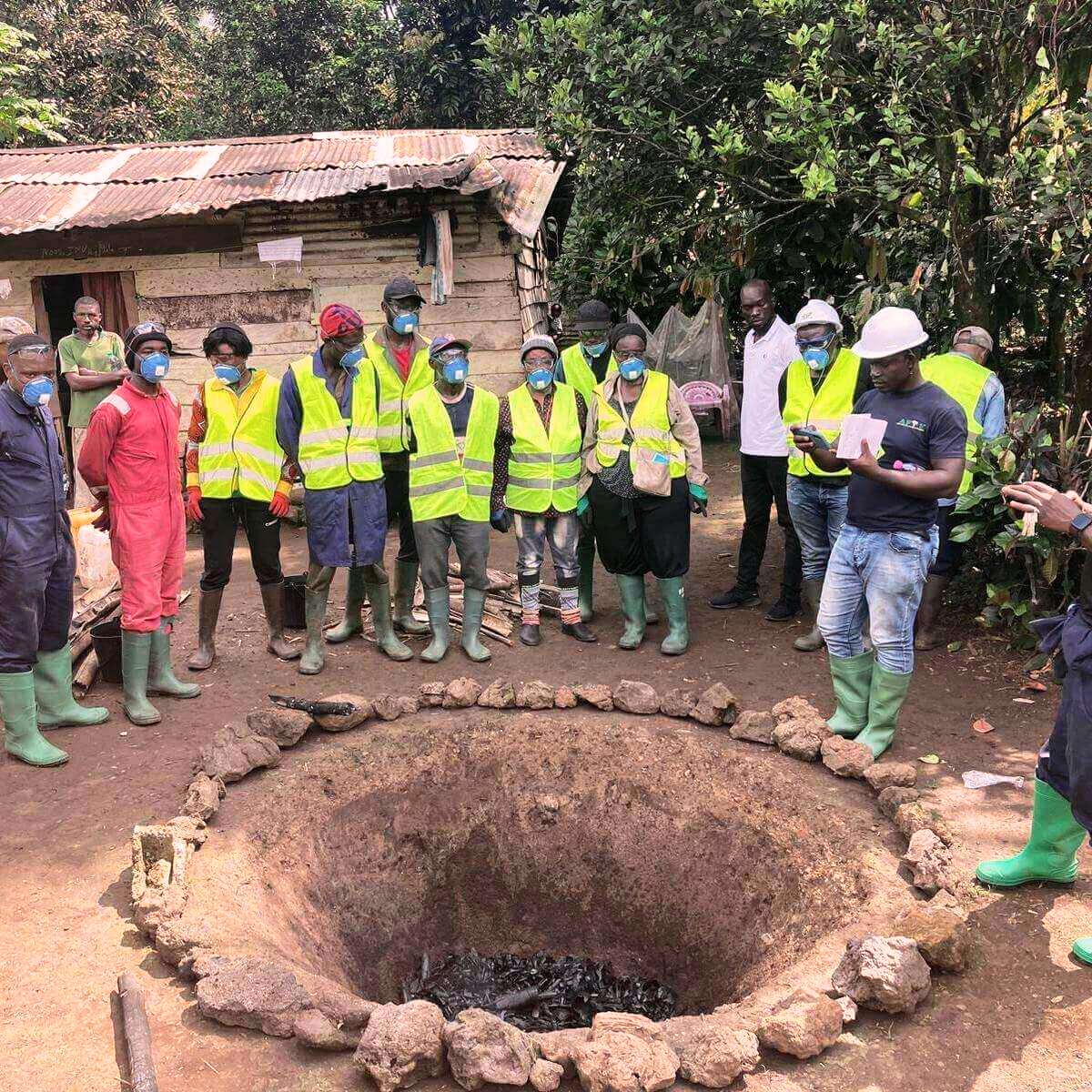
Bild (C) Carbon Connect GmbH
What exactly is it about?
„Was zählt, wenn alles fehlt“
The history of CO₂ is a story of power and inequality.
Countries like the US and the EU have created prosperity through industrial development – and together they have caused almost half of all global CO₂ emissions. Africa? Contributes only about 3%. Nigeria? A mere 0.21%.
But the climate crisis doesn’t stop at national borders.
It affects everyone – just not everyone equally. Those who have accumulated wealth can protect themselves: through infrastructure, insurance, high-tech, and safe havens. The global North has also bought a certain resilience with its emissions. In Nigeria, a country with the largest population in Africa, the situation is different: Millions of people there fight for survival every day – against hunger, violence, disease, and systematic poverty.
There is a lack of many things here: security, clean water, education –
but not of people who are willing to make a difference with their work.
Nigeria as an active part of the solution
Nigeria has the potential to remove up to 50 million tons of CO₂ from the atmosphere every year – using a simple but effective technique:
Biochar .
This is created by the pyrolytic carbonization of organic residues. When introduced into the soil, the CO₂ bound in it is stored permanently – for hundreds of years. And the soil becomes a fertile sponge: It stores water, increases yields, and reduces pesticide use. Carbon becomes hope.
The people who produce this biochar live in rural areas – often without access to a regular income. But almost all of them have access to digital payment systems. This means that money can reach people directly , without intermediaries and without diversions.
And Germany?
In 2024 alone, Germany emitted 572 million tons of CO₂ . The new 2025 coalition agreement stipulates that up to 3% of these emissions can be offset through offsetting abroad. That would be 17 million tons —and thus money that could be channeled into real climate performance and sustainable development.
Money that changes lives in Nigeria, not just counts them.
Nicht Almosen, sondern Ausgleich
With every ton of CO₂ removed through this mechanism, something incredible happens:
People who have hardly contributed to the climate crisis themselves are given the opportunity to become part of the solution through their work – and to sustainably strengthen their ecological environment.
Not because they have to. But because it makes sense.
For their lives. For their land. For our climate. That’s exactly what “climate justice” means.
Your contribution to the UN Sustainable Development Goals (SDGs)
Your money contributes to several key SDGs

SDG 1 – No Poverty:
Creating additional, reliable sources of income for agricultural households in structurally disadvantaged regions.

SDG 2 – End hunger
Strengthening regional food security through long-term biochar-based improvement of soil fertility and thus yields.

SDG 9 – Industry, Innovation and Infrastructure
The use of digital tools (e.g. Biochar App+) as well as standardized verification and monitoring processes supports the development of modern, sustainable infrastructure in rural areas.

SDG 12 – Consume and produce responsibly
By converting organic residues into biochar, local biomass is returned to the cycle – a contribution to the circular economy with social added value.

SDG 13 – Act for Climate Action.
Every verified ton of CO₂ is permanently removed from the atmosphere. Our method meets high standards of credibility and traceability.

SDG 15 – Life on Land
Soil enrichment with biochar regenerates degraded areas, stops erosion, and strengthens biodiversity – for more resilient ecosystems and a revitalization of rural regions.
Carbon becomes hope
Wie Pflanzenkohle Leben verändert
Newsletter
Stay tuned – save the climate & experience the impact!.
Subscribe to our newsletter and find out:
- how CO₂ becomes biochar.
- how small farmers in West Africa benefit.
- how to achieve real impact with your compensation.